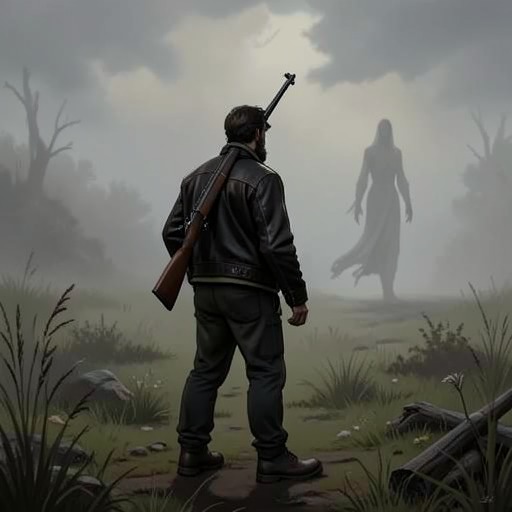
Henry Akeley's Siege
The Colour Out of SpaceHenry Akeley’s siege is a prolonged campaign of nocturnal attacks, road ambushes, and isolation that turns the scientist’s remote farmhouse into a place he cannot confidently leave or defend. Reported through his increasingly urgent letters to Albert N. Wilmarth, the siege advances from unseen presences to dead dogs, gunfire, and a creature whose remains vanish. Akeley’s later claim that he had misunderstood the Outside Beings changes the meaning of the conflict, but does not undo the vivid record of fear and loss that preceded it.
The Threat Closes In
The pressure became unmistakable in early August, when Henry Wentworth Akeley wrote that the hill creatures and their agents were closing in with new determination. Their barking at night had long been a warning; now the danger appeared on roads he needed to travel by day. On August 2, while driving toward the village, Akeley encountered a tree trunk blocking the highway through a deep patch of woods. The barking of the two large dogs with him suggested that something was waiting nearby. He could not know what might have happened without them, and thereafter he would not venture out with fewer than two dogs from his powerful pack.
The road remained dangerous. On August 5, a shot grazed Akeley’s car; on August 6, his dogs barked at unseen presences in the woods. The attacks brought the hidden threat into ordinary routines—driving to the village, using the highway—while keeping the attackers themselves largely out of sight. Akeley’s letters also described the dogs’ response as a kind of alarm system: their barking testified to presences he could not see.
The Farmhouse Under Attack
The siege reached the house on the night of August 12–13. Bullets flew outside, and three of Akeley’s twelve great dogs were found shot dead the next morning. The road bore myriads of claw-prints intermingled with human footprints identified as Walter Brown’s. Akeley tried to telephone Brattleboro for more dogs, but the line went dead. He later learned that linemen had found the main telephone cable neatly cut in the deserted hills north of Newfane. The severed line was not simply a failed means of communication: it left Akeley more isolated as danger gathered around his farm.
He went to Brattleboro for four replacement dogs and several cases of ammunition for his big-game repeating rifle. Even as the attacks intensified, he resisted seeking official help. Albert N. Wilmarth urged him to call in the law and offered to visit Vermont to help explain the danger to the authorities. Akeley instead sent a telegram from Bellows Falls telling Wilmarth to take no action and wait for an explanation. He then revealed that he had neither sent the telegram nor received the letter it answered. A strange sandy-haired man with a thick, droning voice had deposited the message, whose signature misspelled Akeley’s name. The false message turned the correspondence itself into part of the siege: Wilmarth could no longer assume that a reply signed by Akeley had come from him.
Akeley’s subsequent letters described further deaths among the dogs and exchanges of gunfire on moonless nights. Human shoe-prints, including Walter Brown’s and those of at least one or two other figures, appeared regularly among the claw-prints along the road and behind the farmyard. The home he had hoped to defend began to seem untenable. He considered going to live with his son in California, but the prospect of leaving the place he regarded as home was painful. He also wanted to depart quietly, without alarming the countryside or inviting people to treat his account as evidence of madness. For a time, he hoped that giving up his attempts to penetrate the creatures’ secrets might drive them away.
Escalation and Entrapment
The apparent lull offered little comfort. Akeley suspected that full-moon nights were keeping the creatures at a distance and feared the densely cloudy nights that would leave the farm in darkness. He considered boarding in Brattleboro as the moon waned, but the attacks followed. On a thickly overcast night, something landed on the roof. The dogs rushed toward it; one jumped up from the low ell, and a fight broke out above the house amid a frightful buzzing. At the same time, bullets came through a window. Akeley fired from the windows, aiming high enough to avoid the dogs, and believed the immediate attack had ended.
By morning, the yard held pools of blood and foul-smelling green fluid, which also marked the roof. Five dogs had been killed. Akeley thought he might have shot one himself when his rifle fire struck it in the back. He repaired the broken windowpanes and planned another trip to Brattleboro for dogs. Soon afterward, six more dogs were dead. The repeated losses were not incidental casualties: they stripped away the pack on which Akeley relied for warning and protection, while his ammunition and rifle offered no assurance that he could distinguish attackers from his own animals in the dark.
The letters describe the siege as an assault on Akeley’s freedom of movement as much as a defense of the farmhouse. He believed that the creatures meant to take him alive and carry him not only to Yuggoth but beyond the galaxy, perhaps beyond the boundaries of space. Even leaving seemed impossible to him. He thought he might reach Brattleboro, yet felt like a prisoner there as well, and doubted that he could go farther even if he abandoned his possessions. He attributed part of this paralysis to something within his own mind, while warning Wilmarth to stay out of the affair. His isolation was therefore both material—the cut cable, the remote roads, the threatened house—and psychological, expressed as an inability to trust escape.
The Vanishing Creature
Akeley’s account acquired its most tangible evidence when one of his dogs brought down a creature. He found it dead near the kennel and tried to preserve it in the woodshed so he could convince others that the attacks were real. It evaporated within hours. He had seen and touched it, and its tracks suggested a material body, but ordinary photography failed: the developed film showed the woodshed and no creature. Akeley described an immense crab-like form, with fleshy, ringed or knotted structures and feelers where a human head might be. He believed the green fluid found at the house was its blood or bodily juice.
The episode offered proof to Akeley’s senses and withheld it from everyone else. The creature left footprints and could be touched, yet neither its remains nor its image could be produced as evidence. This failure compounded his fear that outsiders would dismiss him as insane, making it harder to enlist help precisely when his isolation was becoming most dangerous. He also connected the vanishing body with creatures seen in rivers after the 1927 flood, which, he noted, had been visible only on the first morning. Meanwhile, Walter Brown had disappeared from the villages where he usually loitered. Akeley suspected he had hit Brown during one of the exchanges of fire, though he believed the creatures tried to remove their dead and wounded.
Akeley’s Reversal
In a letter dated September 6, 1928, Akeley abruptly told Wilmarth that his frightened interpretation had been mistaken, while maintaining that the phenomena themselves were real and important. He reported that communication with the visitors had become actual: in response to signals, he admitted a human messenger from the Outside Beings, who explained their position. Akeley now presented their alleged designs not as a plan to enslave or degrade humanity but as a desire for peace, non-interference, and intellectual exchange. He said that he and Wilmarth had misconstrued allegorical language shaped by profoundly different cultures and habits of thought.
This account reverses the moral explanation of the siege without removing its preceding facts from the record. Akeley now regretted the harm he had inflicted during the nightly skirmishes and said the Outside Beings bore him no grudge. He blamed Walter Brown, described as an inferior human agent, for prejudicing him against them. He also attributed the stolen letters not to the beings themselves but to emissaries of a malign human cult that sought to track and injure them. In this revised account, their drastic precautions were directed against those aggressors, not against ordinary humanity.
The change is striking because it follows the very experiences that had made Akeley certain he was under attack: severed communications, gunfire, dead dogs, a buzzing presence on the roof, and a body that dissolved before it could be shown to anyone. His reversal does not establish, within these letters alone, how every incident should be explained. Instead, the siege remains suspended between two accounts by the same correspondent: first, an increasingly desperate struggle against beings who intend to abduct him; then, an admission that fear and misinterpretation have turned attempted contact into conflict. That unstable testimony is central to the siege’s significance: the reader receives its terror through letters whose interpretation changes even as the underlying events remain unresolved.